From Delivery to Direction
Why service design so rarely shapes business decisions, and the three moves that take designers from delivering the brief to setting the direction.

Most teams already believe in design. Believing in it is not the same as letting it shape a decision. That was the gap I opened the first Service Design Drinks Zürich with.
Does design really drive business?
McKinsey followed 300 listed companies over five years. Those in the top quartile of its Design Index grew revenue 32 percentage points faster than their industry peers, and returned 56 percentage points more to shareholders. The case is made, which makes the real question more uncomfortable.

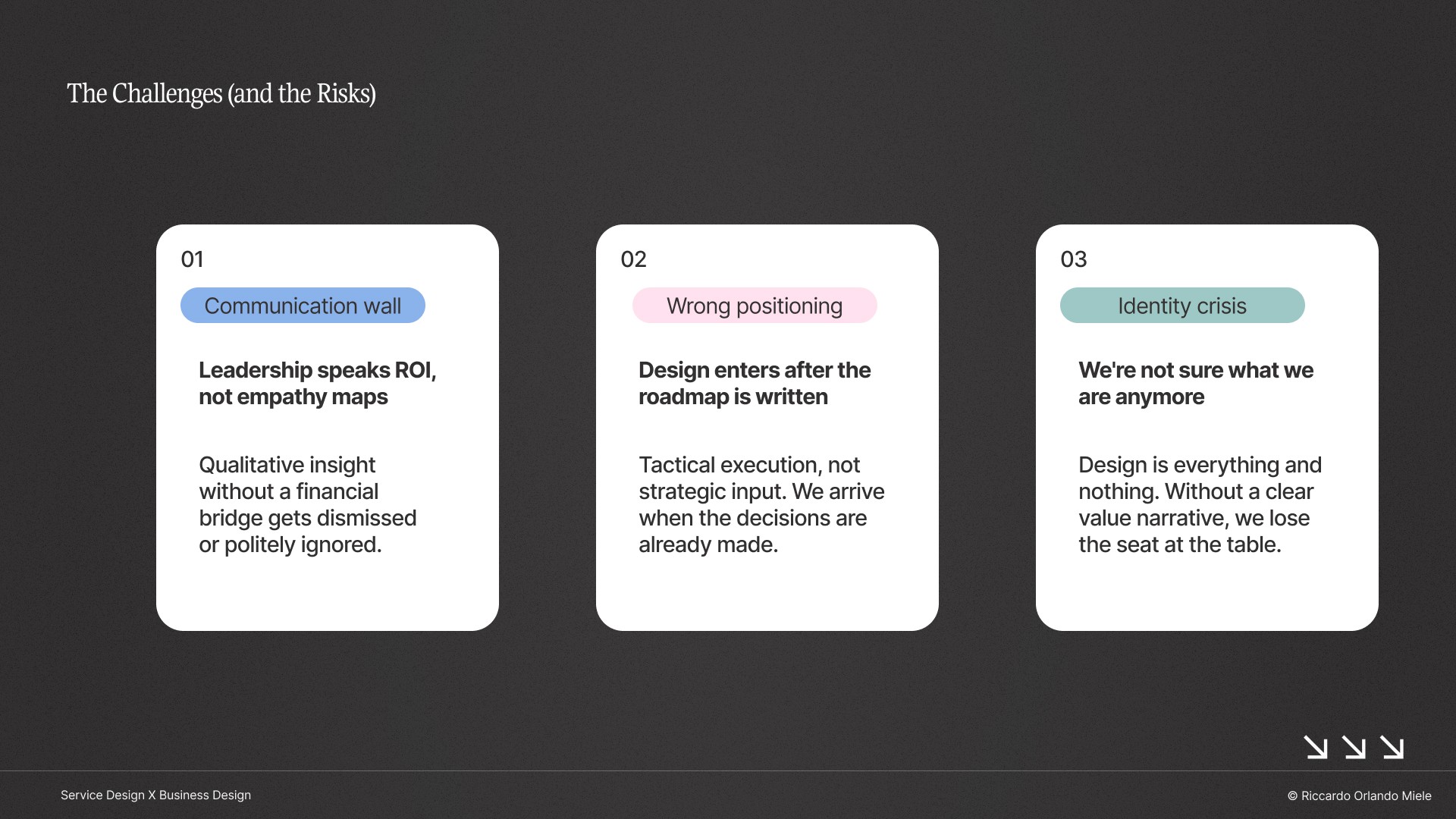


What is really in the way?
Three things, and they feed each other.
Metrics. Leadership asks for ROI, not empathy maps. Design has to learn the language of KPIs, but a value defined only by efficiency turns it into a sterile optimiser. What is meaningful matters as much as what is measurable.
Timing. Design is called in when the roadmap is already written, to fix flows and edge cases. The real work starts earlier, when someone decides which problem is worth solving.
Identity. Design is still misread, especially in organisations with constant re-orgs and silos. That is a perception gap, not a skill gap.
How does design earn its influence?
Business fluency is a tool. Identity is the foundation. From there, three steps.
Build credibility. Assess design maturity, pick the battles worth fighting, make the value argument visible.
Win the people closest to you. Keep delivering, but change the narrative: fewer support calls, hours saved, better task completion. Start with small wins. Proxy metrics are fine when analytics are missing: we don’t need perfect data, we need compelling evidence.
Act like a strategist. Run co-creation sessions that zoom out: challenge assumptions, explore alternatives, frame problems rather than features.
What if something else promises a faster return?
A rebrand or a new feature can deliver a quick win. It was the sharpest question from the room, and my answer was another question.
Do we want to win the quarter, or win the relationship?
Quick interventions can spike a metric, but without a solid service behind them the momentum fades. Service design de-risks them. It is not either/or, but for traction that lasts it is the smarter foundation: return that compounds.
Why does design belong at the strategy table?
AI, automation and complexity risk commoditising design. What cannot be commoditised is the mindset: questioning the brief, turning chaos into clarity, creating value for users and for the business at once. Sense-makers and bridge builders, not cost-cutting optimisers.
Let’s stop waiting for the brief. Let’s start shaping the strategy.

