AI in Autonomous Buildings
A keynote at UX@Siemens Munich 2026 on the principles that keep the experience excellent as AI takes on autonomous buildings.

At UX@Siemens in Munich I spoke to the Siemens design community about the principles that should hold up every AI experience in the autonomous buildings to come.
Fifty years of human–computer interaction fit in four words: keyboard, screen, touch, voice. Each step brought the interface closer to us, yet we were always the ones reaching out to the machine. The next step is not a new device. It is how intelligence shows up in the places where we already work.
What happens when buildings start to anticipate?
Picture a Tuesday morning. Before the meeting starts, the room has set the temperature for six people and pulled energy back from the empty floors. Nobody opened a dashboard. That is Siemens’ published vision of the autonomous, human-centric building: a partner, not a container.
The reality is more modest: most software in this space still lives in dashboards, much closer to the start of the journey than to its end. The road to autonomy is not one big leap. It is a thousand small decisions about how intelligence shows up in the products people use every day.
Teach machines to show up in a way people can trust.





Why is this a design question?
Every team building software asks the same things. When should AI speak? When should it stay quiet? How much space should it take? These are design questions, not engineering ones, and most teams answer them alone.
But users feel the result: a different AI in every product, a different promise on every screen. They will not put a name to it. They will just sense that something is off, and trust is very hard to rebuild.
What does good look like?
Intelligence is a relationship before it is a feature, and relationships rest on a few things.
Trust. People need to see what the system did and why, before they hand it more.
Control. Autonomy is a dial, not a switch. A human stays on the loop and can step in at any moment.
Intention and memory. The system understands what someone is trying to do and remembers it across surfaces, so the experience feels like one thread, not many tools.
How do you bring this to your team?
Start from a real working day, not from the technology. Evangelising UX for AI is mostly about giving teams a shared language and a way of asking the right questions before they design the answers.
Information is engineered, agency is governed, care is designed.
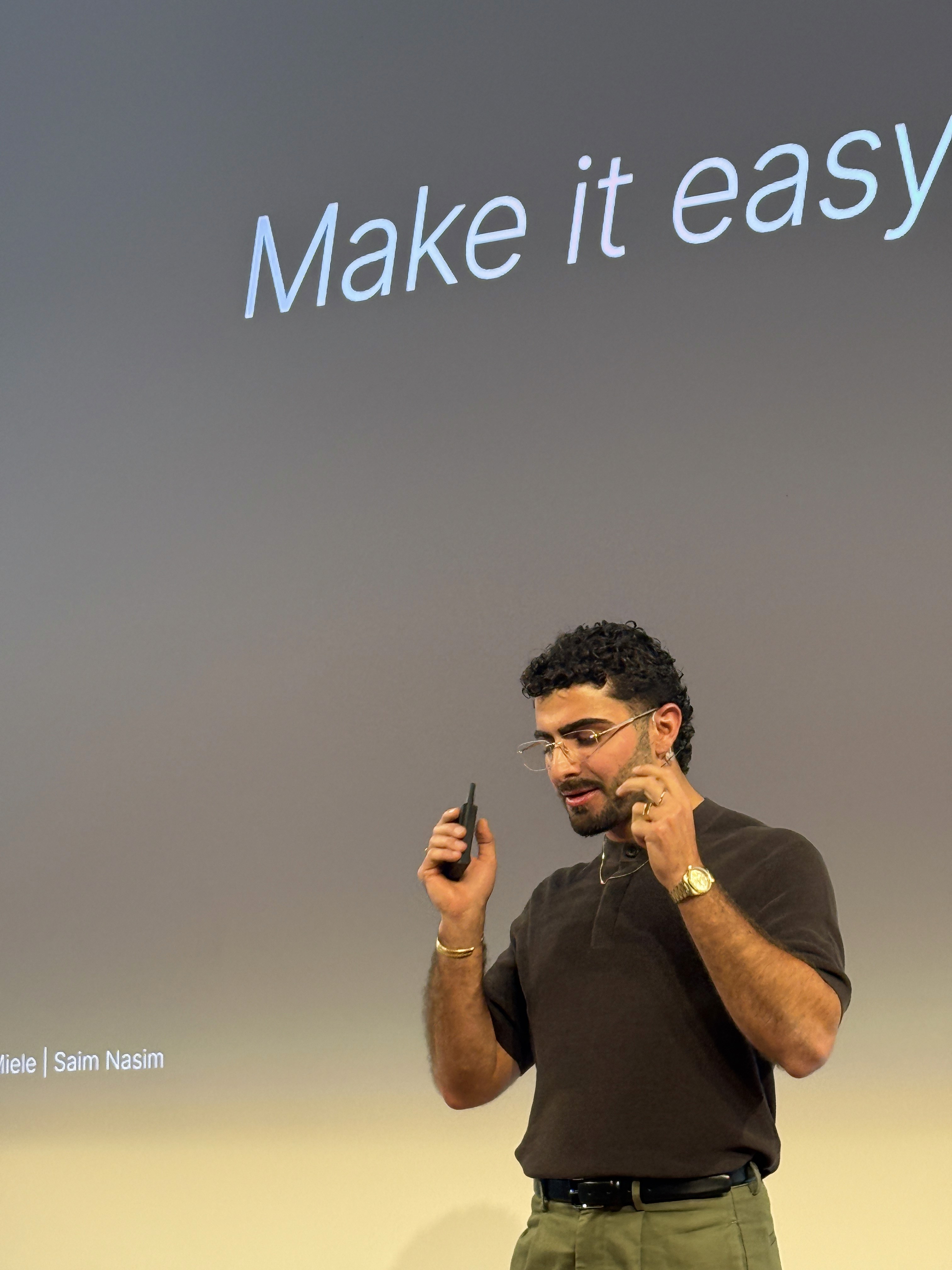


Keynote at UX@Siemens in Munich, 2026, to the Siemens design community of 450+ UX professionals across onsite and online participation, together with Saim Nasim.